Mount Toubkal Trek Difficulty, Fitness, and Kit List
Standing on the stony roof of North Africa at dawn with numb fingers makes you forget the endless loose scree you cursed an hour earlier. When people ask me about the mount toubkal trek difficulty, my first response is usually simple: it is not technical, but it will humble you if you arrive unprepared. You do not need climbing ropes or ice axes in mid-summer, yet you are still climbing past 4,000 meters on rough, unrelenting mountain tracks.
I wrote this breakdown after several trips up from Imlil, having watched ultra-runners sprint up like mountain goats while reasonably fit weekend walkers turned around with pounding altitude headaches at the South Col. The mountain sits at 4,167 meters. That elevation alone introduces physiological hurdles that no amount of flat-ground walking can simulate. Beyond the thin air, the terrain throws steep scree gullies, ankle-twisting boulder fields, and unpredictable weather at you, so let us break down the physical demands, packing essentials, and route realities before you lace up your boots.
Book your mount toubkal trek experience:
Understanding Mount Toubkal Difficulty: Scree, Scrambling, and Thin Air
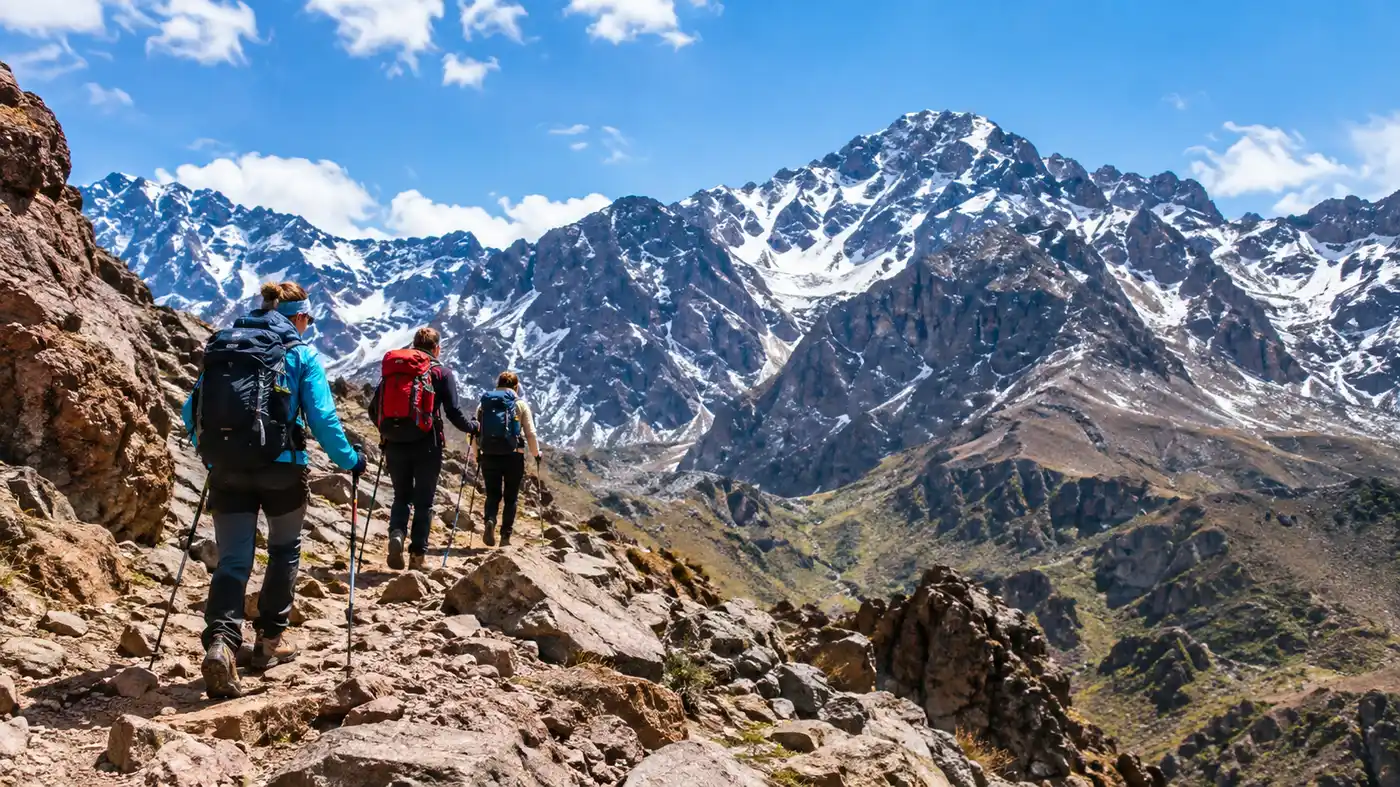
Toubkal is technically classified as a walk-up. That label causes plenty of grief. People hear "walk-up" and imagine a manicured footpath through rolling hills, maybe stopping for an espresso halfway up. What you actually encounter on summit day is a relentless, chaotic staircase of fractured granite, quartzite, and loose volcanic shale. The path drops out from under your feet. For every two steps forward on the upper South Cirque, you slide back half a step in deep gravel.
The altitude creates the real dividing line. Up to the mountain refuge at 3,207 meters, most people do fine if they keep an easy, conversational pace. Above the refuge, atmospheric pressure drops, and each breath delivers noticeably less oxygen to your working quadriceps. You will feel your heart hammering against your ribs on slopes that would feel routine at sea level. Headaches, mild nausea, and a weird loss of appetite are common companions above 3,500 meters.
Then comes the South Cirque. It looks like a giant quarry tipped on its side. There are multiple braided trails scratched into the scree, none of them particularly stable, and you are navigating them in pitch darkness with a headlamp beam cutting through dust. It demands constant mental focus so you do not roll an ankle or kick loose stones onto someone climbing fifty feet below you. It is a slow, rhythmic grind rather than a technical climb, but it drains your mental energy quickly if you are not used to wild, uneven ground.
Note: Moroccan law strictly requires foreign hikers to trek with an authorized local guide and register at the police checkpoints in Imlil and Aroumd, so solo unguided attempts are no longer permitted.
Mount Toubkal Trek Distance and Stage Breakdown
The total round-trip distance from Imlil to the summit and back is roughly 31 kilometers, though your GPS will record closer to 33 or 34 kilometers once you account for zig-zagging up the gullies. If you tackle the standard Mount Toubkal 2-day trek itinerary, you split this distance unevenly. Day one handles the approach hike to the base camp, while day two covers the savage vertical push to the summit followed by the knee-jarring descent all the way to the valley floor.
Here is how the stages compare across terrain, vertical gain, and average walking time based on a standard summer trek:
| Trek Stage | Distance | Elevation Gain / Loss | Typical Time | Terrain Type |
|---|---|---|---|---|
| Imlil to Refuge | 11.5 km | +1,467 m | 4.5 to 6 hours | Packed dirt, mule paths, rocky riverbeds |
| Refuge to Summit | 4.5 km | +960 m | 3 to 4.5 hours | Loose scree, broken rock, minor scrambling |
| Summit to Refuge | 4.5 km | -960 m | 2 to 2.5 hours | Sliding scree runs, boulder hopping |
| Refuge back to Imlil | 11.5 km | -1,467 m | 3.5 to 5 hours | Gentle descent on stony trail |
The sheer drop on summit day catches people off guard. Dropping nearly 2,500 meters in a single afternoon from the cold wind of the summit down to the heat of the walnut groves will punish your joints. Your knees absorb thousands of impacts on tired legs. It is why trekking poles are completely non-negotiable for anyone who values their cartilage.
Fitness Requirements: Can an Average Hiker Make It?
You do not need to be an ironman competitor to climb Toubkal. Regular people finish this trek every week. If you can walk for 6 hours across hilly countryside with a light daypack without collapsing on the sofa for two days afterward, you have the baseline engine to reach the refuge. The summit day demands a bit more grit.
Aerobic endurance matters far more than raw muscle mass. Long, steady cardio sessions build the capillary density and lung efficiency you need when the air thins out. Running, stair climbing with a loaded backpack, cycling, or spending long weekends hill-walking in damp weather will pay enormous dividends once you pass the 3,500-meter mark. If you live somewhere flat, spend quality time on the gym stair-master set to a slow, steady pace for 45 to 60 minutes twice a week.
Your leg strength needs to focus on eccentric loading. That is the tension your quadriceps hold while lowering your body step by step on the descent. Weak quads lead to shaky knees, which lead to sloppy foot placement, which leads to sprained ankles. Split squats, lunges, and step-downs build the stability muscles around your knees and ankles far better than heavy leg presses.
Mental stubbornness counts for at least a third of the effort. When you wake up at 4:00 AM inside a chilly stone refuge, pull on cold boots, and face a wall of dark rock under a freezing wind, your brain will produce half a dozen convincing reasons to crawl back into your sleeping bag. Hikers who push past the early morning nausea and keep moving one foot in front of the other almost always make it to the metal pyramid on the summit ridge.
Pro tip: Fill your water bottles with warm water before leaving the refuge in the morning, and wrap them in a spare fleece to stop the valves from freezing solid on the ridgeline.
Book your mount toubkal trek experience:
Essential Mount Toubkal Trek Kit List
Packing for Toubkal involves managing temperature swings of 25 degrees Celsius within a single day. The valley in Imlil can sit at a sweltering 30°C in July, while the summit ridge before sunrise easily dips to -2°C with wind chill. Cotton clothes are your enemy here. Once cotton gets soaked with sweat on the hike up to the refuge, it holds moisture, turns cold, and pulls heat straight out of your core when you stop moving.
I organize my kit into distinct systems to keep weight down and prevent rummaging through my pack in cramped dormitories:
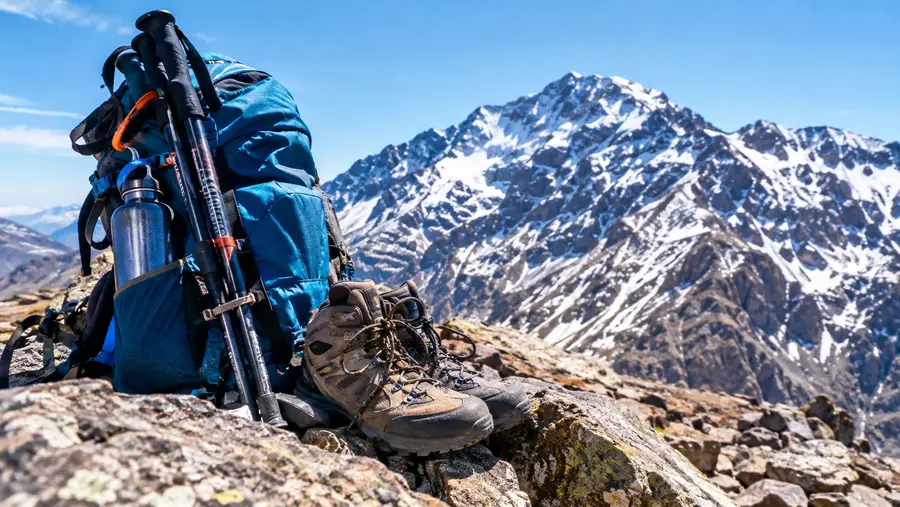
- Footwear system: Broken-in mid-cut hiking boots with stiff ankle support, two pairs of merino wool hiking socks, and a light pair of camp shoes or slides for relaxing inside the refuge.
- Layering clothing: Two synthetic or merino base layer tops, one lightweight fleece jacket, an insulated down or synthetic puffy jacket for summit morning, and a reliable waterproof shell jacket that blocks wind.
- Trekking trousers: Sturdy convertible hiking pants or softshell trousers; avoid heavy denim or pure cotton cargo pants that soak up mud and water.
- Extremities and warmth: A warm fleece beanie, a wide-brim sun hat for the lower valley, lightweight glove liners, plus windproof winter gloves for the freezing summit ridgeline.
- Hardware and illumination: A reliable headlamp with at least 250 lumens and fresh spare batteries, sturdy adjustable trekking poles with flick-locks, and UV category 3 or 4 sunglasses to protect against high-altitude glare.
- Hydration and health: Two 1-liter reusable water bottles or a wide-mouth Nalgene (hydration bladders often freeze in the hose above 3,800 meters), water purification tablets, blister pads, ibuprofen, and a small packet of rehydration salts.
If you plan to hike between November and May, this packing list changes completely. The scree turns into hard-packed alpine snow and ice, turning the mountain into a proper mountaineering route. Check our dedicated winter climbing guide before attempting those conditions, because you will need rigid B2 boots, crampons, an ice axe, and real experience using self-arrest techniques.
Honest Mount Toubkal Trek Advice and Route Realities
Take the first three hours out of Imlil slower than you think you need to. The trail leaves the village through dusty dirt tracks past walnut trees and apple orchards, following the Mizane valley toward the shrine village of Sidi Chamharouch. Eager hikers often march out at three miles an hour, feeling fresh on the packed trail. By the time they clear the shrine at 2,310 meters and face the steeper switchbacks up to the refuge, their legs are cooked and dehydration sets in.
Sidi Chamharouch makes a great rest stop. Local vendors sell fresh orange juice pressed right in front of you, cooled by mountain stream water. Grab a glass, drink half a liter of clean water, and eat a handful of dried figs. Keep your pack light by having the mule carry your main duffel bag up to the refuge. Carrying a 15-kilogram backpack over 1,400 meters of vertical gain on day one serves no purpose unless you are deliberately training for an unsupported expedition elsewhere.
Sleep at the refuge is almost universally poor. The dormitories at both Refuge du Toubkal and Les Mouflons pack dozens of hikers into shared bunk platforms. People snore, alarms go off at 3:30 AM, and the high altitude gives many sleepers weird, vivid dreams or mild sleep apnea. Bring high-density foam earplugs and an eye mask. Even resting quietly with your eyes closed for six hours is enough to recharge your system for the summit push, so do not panic if deep sleep eludes you.
Descending the South Cirque scree on the way down requires a deliberate technique. Rather than stepping gingerly on the tips of your toes - which almost guarantees your feet will shoot out from beneath you - lean back slightly, plant your heels into the soft gravel, and let your body ski down the loose scree runs. It feels counterintuitive at first. Once you trust the gravel to catch your heels, you can drop 500 meters of elevation in twenty minutes with minimal strain on your knees.
Frequently Asked Questions about mount toubkal trek difficulty
Is Mount Toubkal suitable for absolute beginners?
Yes, provided you have good basic cardiovascular fitness, sturdy hiking boots, and reasonable expectations about rough terrain. It should not be your very first mountain hike, but someone who regularly walks, runs, or visits the gym can complete it comfortably with an experienced local guide setting a measured pace.
How dangerous is the altitude on Toubkal?
At 4,167 meters, the risk of acute mountain sickness (AMS) is real, especially on rushed two-day itineraries. Most hikers experience mild symptoms like dull headaches or shortness of breath. Serious complications like pulmonary or cerebral edema are rare on Toubkal because you descend quickly after reaching the summit, but you must descend immediately if severe dizziness, vomiting, or confusion develops.
Can I do the trek in trail running shoes instead of heavy boots?
In mid-summer, experienced trail runners often hike in sturdy trail shoes with rock plates and aggressive lugs. For most hikers, however, mid-cut boots with firm ankle support and stiff soles are much safer because the scree fields on the South Cirque are sharp, loose, and very unforgiving on soft footwear.
Do I need an ice axe and crampons in summer?
From late June through late September, the standard normal route is generally free of snow, meaning standard boots and trekking poles are sufficient. Residual snow patches sometimes linger in shaded gullies until early July, so always ask your guide in Imlil about current route conditions before leaving the valley.
Quick Reference
- Elevation: 4,167 meters
- Total distance: 31 kilometers round-trip
- Summit day gain: 960 meters from refuge
- Required skill: Non-technical strenuous hill-walking
- Mandatory: Local licensed mountain guide
Book your mount toubkal trek experience:
The Bottom Line
Mount Toubkal offers one of the most accessible 4,000-meter summit experiences on earth, sitting just a short drive and a couple of days' walking away from Marrakech. It gives you a genuine high-altitude mountain adventure without demanding years of technical climbing practice or weeks of high-altitude acclimatization. Treat the scree with respect, pack warm windproof layers no matter how hot the Moroccan lowlands feel, drink plenty of water along the trail, and the climb will be one of the best mountain memories you ever collect.
Read more about mount toubkal trek.